








Indiana Tech, Huntington University nursing partnership a unique and tangible success
July 8, 2026When universities combine their strengths around a shared mission, the results can extend far beyond either campus. The Accelerated Bachelor of Science in Nursing (ABSN) program is a prime example—a collaborative partnership between Indiana Tech and Huntington University that was created to help address the region’s growing need for healthcare professionals while opening a faster pathway into nursing for students seeking a second career.
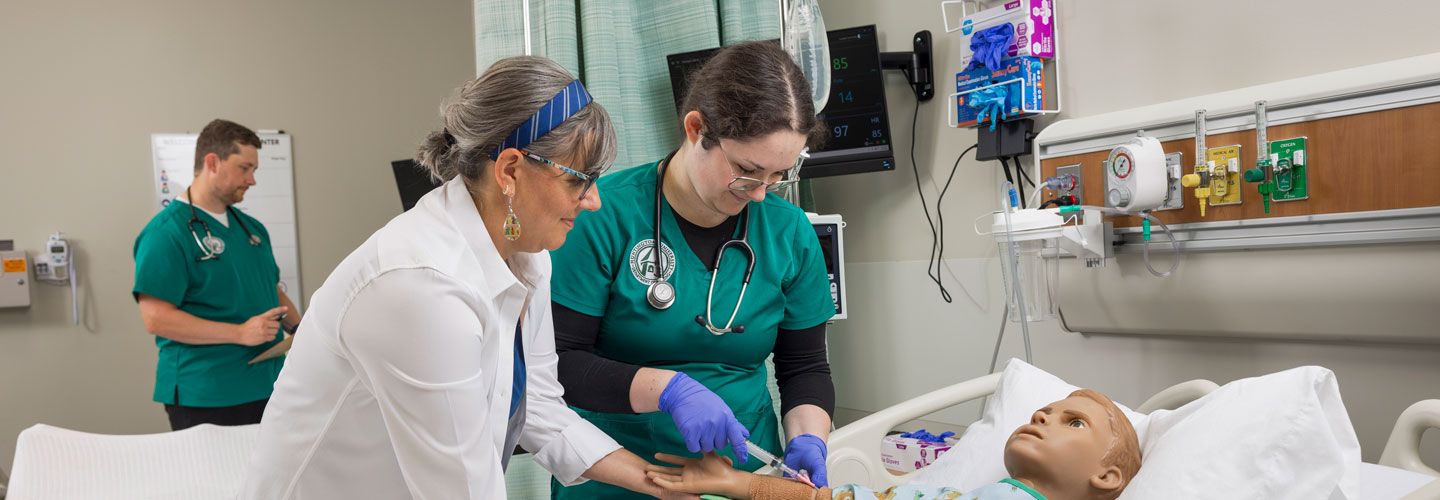
The ABSN is a full-time, 13-month program taught by Huntington University’s experienced nursing faculty, culminating in a bachelor’s degree from the university. Coursework is taught in specialized nursing classrooms in the Keene Building on the Indiana Tech campus. Hands-on, clinical work is conducted at Parkview Health facilities in Fort Wayne.
Indiana Tech and Huntington University launched the program in 2023, with help from Parkview Health and the Questa Foundation. It was built as a response to nationwide shortages that became apparent when more than 100,000 registered nurses left the profession during the COVID-19 pandemic.
Huntington University Director of Nursing Jodi Eckert is thrilled with how well-established and respected the program has become in that time.
“Enrollment has steadily increased over time, and we have continued to see strong interest from individuals seeking a second career in nursing or a more accelerated pathway into the profession,” Eckert said.
Aspen Hill is a graduate of the program. Hill earned her bachelor’s degree in general studies with minors in French and autism spectrum disorders from Ball State University. After taking a few years to find the right career path, she decided to commit to the ABSN program during its pilot year.
“I am grateful that this program exists,” Hill said. “This program gave a seemingly impossible goal a realistic timeline. Although it was not easy by any stretch of the imagination, it was achievable due to having fantastic support.”
The accelerated timeline came with some challenges, notably the pressure that if she forgot certain details, she could bring harm to another person. Hill called that pressure a useful tool in preparing her to function at her fullest potential in the chaos of working as a nurse, and her success would not have been possible without a strong support system of instructors.
“From day one, everyone was present and attentive; they worked so hard to make sure that every voice was heard,” she said. “We had a roundtable talk the very first day we met as a group. The intimate setting set my mind at ease knowing that the facilitators of this journey aren’t treating me like a statistic, but a person.”
That sentiment holds true for current students, as well. Chris Fox received his bachelor’s degree in biology from Huntington in 2013 and came to the ABSN program this year. He was drawn to the program, in part, because of the school’s high standards and his familiarity with the quality of its instructors.
“The nature of the program lends itself to knowing each professor on a personal level,” Fox said. “They are all approachable and willing to listen and help resolve any issues as they arise.”
Melanie Peters earned her bachelor’s—also in biology—from Olivet Nazarene University in Bourbonnais, Illinois before moving to Fort Wayne two years ago. She was looking into traditional nursing programs before discovering the ABSN.
“I knew it was going to be fast paced due to it being an accelerated program,” Peters said. “With that being said, the professors continuously show that they want to help us succeed and are very understanding of life circumstances that all the students have. The professors are all very passionate about teaching nursing and providing the best care possible for the patients.”
For students who complete the degree, the Parkview ABSN Scholars Program provides full funding of their tuition in addition to job offers. That tuition support was one of the reasons Hill chose the program.
The program boasts a 100% job placement rate for graduates, and Eckert says approximately 86% continue serve Northeast Indiana, often receiving high praise from the facilities they work for.
“We also know that retention matters,” she said. “Our graduates are not only obtaining positions, but they are succeeding within those roles because they enter practice with strong clinical reasoning skills, a solid professional foundation and the ability to work effectively within healthcare teams.”
Hill remains active in the field since graduating, serving full-time in the neurosurgery operating room while also being involved in a home-health start-up. She says she has found the skills she learned from the ABSN program translating more to the latter than when she’s in the operating room.
“It is a big commitment, but it is worth every moment,” Hill said. “You can expect to put a lot of work in, but you are never alone and every instructor and faculty member wants you to succeed. They are valuable resources and will help you in any way that they can. I would pick this program all over again based on the people alone.”
Meanwhile Peters, who currently serves in the emergency department and on a critical transport ambulance, hopes she can continue to work in those settings upon completing the ABSN program.
“I feel that the fast pace of the program will help me do well in critical care because it’s helping me work on my time management and prioritization skills,” Peters said.
Eckert emphasizes the priority of investing in the success of students from day one to graduation and beyond, noting that students are never alone.
“I would encourage prospective students not to underestimate what they are capable of,” Eckert says. “We have seen students from many different backgrounds enter this program, grow tremendously throughout the process and ultimately become exceptional nurses and leaders within healthcare.”
That is proving true for Peters and Fox, who each came to the ABSN program with degrees in fields unrelated to healthcare.
“I had felt stuck trying to decide what I was going to do next once I decided that I wanted to go into nursing after already getting my first degree at a 4-year university,” Peters said. “I had originally thought I was going to have to start over with my education, including general education courses, and this program makes it so that I don’t have to totally restart.”
“If someone is serious about fast-tracking a career in nursing, this is an excellent opportunity to do just that,” said Fox. “The program is excellent, the faculty are incredibly knowledgeable and the experiences are invaluable.”
Indiana Tech President Dr. Karl Einolf says the program gives aspiring medical professionals an opportunity to better position themselves for success in their career pursuits.
“The ABSN partnership with Huntington University demonstrates the good that can happen when two institutions come together to benefit students,” Einolf said. “It is another positive example of the many ways Indiana Tech is preparing students for lives of significance and worth.”
As a result of growing interest and the continued need for healthcare professionals in the region, the Indiana State Board of Nursing recently approved an increase in cohort capacity, which will allow the program to serve more students in the future.
Parkview chief nursing and healthcare markets executive Juli Johnson says they are proud to be involved in a partnership offering an innovative, accelerated pathway for future healthcare professionals.
“Indiana Tech’s focus on expanding access to flexible, high-quality education, combined with Huntington University’s strong nursing program, creates a powerful model for preparing future nurses,” Johnson said. “By providing hands-on clinical experience and mentorship, we can ensure students are ready to deliver high-quality care from day one.”
Eckert says growth can be seen in more than just class size.
“Clinical partnerships have expanded, simulation and learning resources have advanced, and the program has continued to evolve in response to the changing healthcare environment,” she said. “Most importantly, we have seen the development of a strong community within the program, one that is highly collaborative, supportive, and deeply connected to the mission of preparing compassionate and practice-ready nurses.”
Forty-two students are currently participating in the program, with an additional 40 set to begin in the fall. Of the current cohort, 21 will graduate in October with the other half following in March.